Authors: Danna Titelboim, Ahuva Almogi-Labin, Barak Herut, Michal Kucera, Sarit Asckenazi-Polivoda & Sigal Abramovich
Journal: Scientific reports
DOI: https://doi.org/10.1038/s41598-019-40944-5
Abstract
The Eastern Mediterranean is experiencing a large-scale invasion of alien tropical species from the Red Sea. This “Lessepsian invasion” began with the opening of the Suez Canal and is promoted by the ongoing oceanic warming. The environmental differences between the Red Sea and the Mediterranean act as a buffer allowing the invasion of certain species. This provides an opportunity to study the differences in temperature sensitivity between two sibling species of the cosmopolitan foraminifera Amphistegina. Both species are very common in the Red Sea. While only one is a successful invader, and the other is absent in the Eastern Mediterranean. Here we show that the two species are different in their temperature sensitivity, which explains their selective invasion into the Mediterranean. These differences demonstrate that in respect to climate change, resilient marine species can be distinguished by their ability to compensate for temperature changes by adjusting their physiological performance and by having tolerance to a wider temperature range. Moreover, we demonstrate that selective filtering mechanisms during invasion can prefer species that are more resilient to colder rather than expected warmer temperatures.
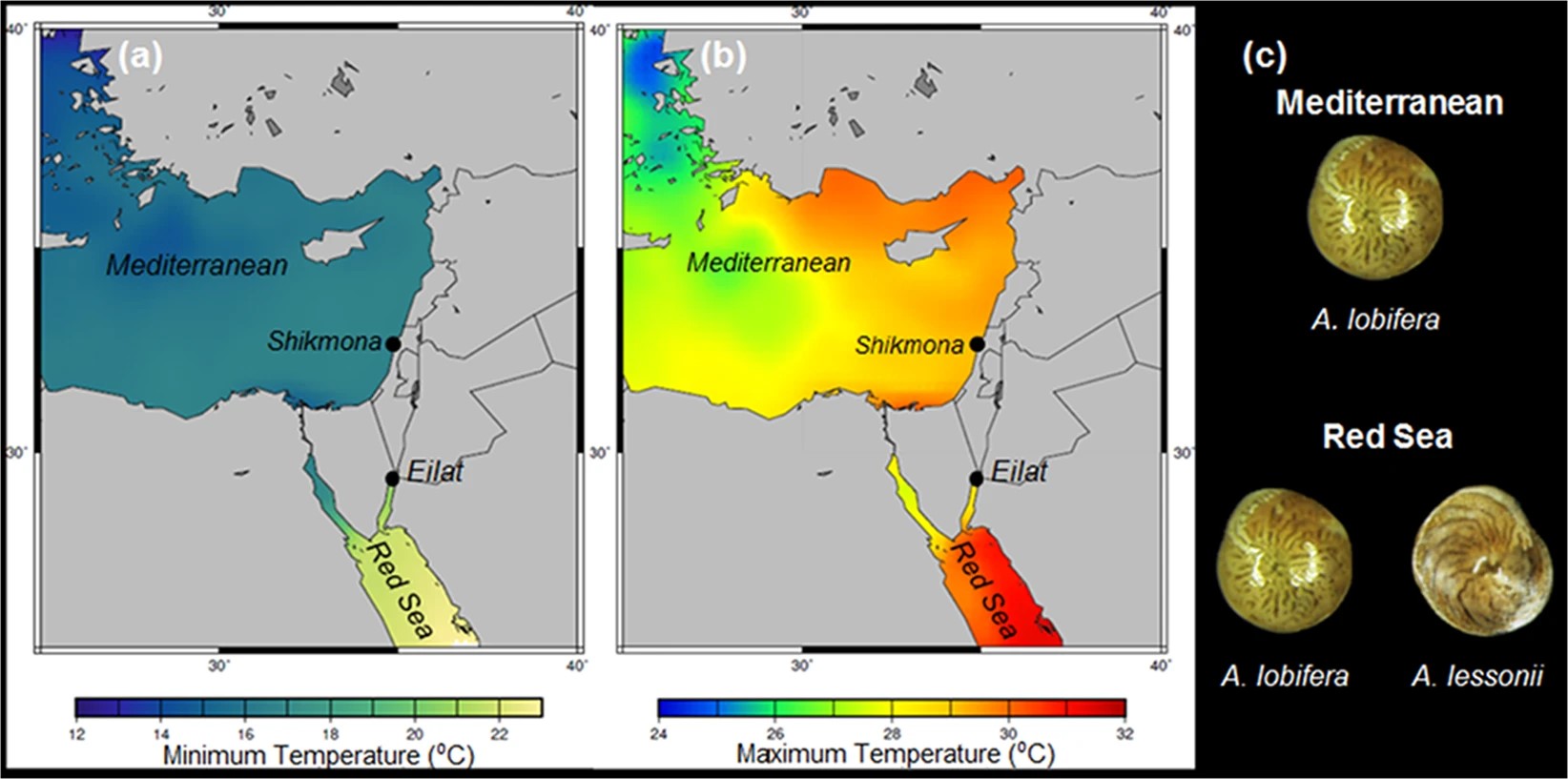
Minimum (a) and Maximum (b) temperatures in the studied area (temperature data taken from Bio-ORACLE). Black dots represent the sampling sites in Shikmona (Eastern Mediterranean) and the Gulf of Aqaba-Eilat. Note the differences in minimum and maximum temperatures between the Red Sea and Mediterranean. In the Eastern Mediterranean, the average range of winter lows-to summer highs is 13 °C–31 °C, compared with 22 °C–28 °C, in the Gulf of Aqaba (the north-eastern branch of the Red Sea). (c) Digital images of the two studied species A. lobifera and A. lessonii from the two studied locations